Generative AI & Agentic AI Certification Program

4.7 Google Reviews
  • Build projects and learn.
  • Learn 10x Faster in Kannada.
  • Get Trained by Experts from OpenAI, Amazon, Google, NVIDIA & more.
  • Master Generative AI, LLMs, Prompt Engineering, RAG, and Agentic AI Systems

Key Highlights

Duration: 3 - 4 months
Instructor led Live online classes
Morning & Evening batches focused for IT professionals
The only platform to teach in kannada
Community support for doubt clarification
Course Completion / Internship Certificate
Career training for resume building & mock interviews
Assured interview opportunities*

4.7

Google Reviews

4.8

Glassdoor

4.8

Shiksha

ಕನ್ನಡದ No.1 Tech-Skilling Platform


0 +
Active Students

0 +
YouTube Subscribers

0 +
Instagram Followers

0 +
Telegram Followers

Our Mission: Skill 5 lakh Learners by 2027

Meet Our Trainers & Experts

Gaurav Kamath

Co-Founder | Tech Education Expert | Ex-Infosys, Accenture, Tracxn

With 10+ years of industry experience, Gaurav has worked with leading IT firms like Infosys and Accenture. An engineer from Nitte, he now focuses on building practical Cloud and DevOps learning programs for modern tech careers.

Rakesh Kothari

Co-Founder | Cloud & Automation Mentor | Ex-TCS, Bank of America

Rakesh brings 15+ years of IT expertise across TCS and Bank of America. An engineer from BMS College, he specializes in Cloud, Automation, and AI-driven solutions that help professionals upskill faster.

Manikanta Nair

Co-Founder | AI & Full Stack Mentor | Ex-Industry Professional

With 7+ years of experience, Manikanta has developed scalable tech solutions and mentored learners in AI and Cloud technologies. An engineer from PACE, he focuses on simplifying next-gen tech concepts through practical, hands-on learning.

What are the top job roles in Generative AI?

AI Developer / Gen AI Engineer

Designs and builds Gen AI based apps using LLMs and APIs (OpenAI, Bedrock, Gemini).

LLM Application Developer

Integrates AI APIs and frameworks like LangChain, CrewAI, and LangGraph for business applications.

Agentic AI Engineer

Builds multi-agent systems capable of reasoning, collaboration, and autonomous execution.

AI Product Builder

Develops AI-based copilots and assistants that solve domain-specific problems.

AI Solutions Architect

Designs scalable and secure AI workflows integrating LLMOps, RAG, and orchestration frameworks.

Data & Cloud Professional (AI Track)

Upskills into Generative AI to deploy AI applications on AWS, Azure, and GCP.

MicroDegree vs Competition — Feature Comparison

Language advantage

MicroDegree

Learn 10x faster in Kannada

Typical Competitors

Mostly English only delivery

Batch flexibility

MicroDegree

Switch any batches within a year

Typical Competitors

Fixed batches, limited flexibility

Trainer quality

MicroDegree

Active IT professionals & industry experts

Typical Competitors

Professors with limited real world exposure

Course pricing

MicroDegree

Affordable & ROI-driven pricing

Typical Competitors

Often charge ₹1 - 3+ lakhs

Target audience

MicroDegree

Designed for mid & senior IT professionals

Typical Competitors

Cater to everyone → mixed cohort quality
Tools Used

OpenAI logo used in the Generative AI courseOpenAI
Bedrock logo used in the Generative AI courseBedrock
MCP logo used in the Generative AI courseMCP
CrewAI logo used in the Generative AI courseCrewAI
Dotenv logo used in the Generative AI courseDotenv
Chroma logo used in the Generative AI courseChroma
Gradio logo used in the Generative AI courseGradio
Pinecone logo used in the Generative AI coursePinecone
Pydantic logo used in the Generative AI coursePydantic
Jsonschema logo used in the Generative AI courseJsonschema
Docker logo used in the Generative AI courseDocker
Streamlit logo used in the Generative AI courseStreamlit

Generative AI Course Curriculum

15 modules

Module 1 – AI Foundations & Prompting for IT Professionals
  • Program orientation and how LLMs really work: tokens, context window, training vs inference, why models hallucinate. Each learner states the one job task they will improve by the capstone.
  • The prompt pattern Task → Context → Input → Constraints → Output → Check; managing context across a conversation; AI as a tutor for any new tool or technology.
  • Validating output and handling data responsibly: what may and may not be pasted into an AI tool, company policy, citing sources.
Module 2 – Claude Environment: Chat, Projects & Artifacts
  • Chat versus workspace: setting up a Project with instructions and reference files; what the AI sees and what it does not.
  • Document analysis: long documents, comparing versions, extracting tables, answering with citations.
  • Building a role assistant: instructions, a prompt library, a voice and limits; quality checklists and sharing it with a team.
  • Artifacts: editable documents, tables, Mermaid diagrams and simple interactive pages.
  • Professional documents and training content: proposals and policies in house style; turning an SOP into a course outline, job aid, quiz and slide deck as Word and PowerPoint files.
Module 3 – Data Views & Reports with AI
  • Analysing data with AI: cleaning an export, grouping by week, month, quarter and year, and checking the totals.
  • Charts, dashboards and summaries: one chart and one paragraph per period, written for a manager.
Module 4 – Claude Skills, Connectors & Cowork
  • Claude Skills: packaging a repeatable procedure so anyone can run it.
  • Connectors and their risks: drive, email, calendar, Jira, Confluence; read versus write access, least privilege, and an everyday introduction to prompt injection.
  • Claude Cowork and Claude in Chrome: multi-step tasks over files, apps and web pages, where they fail, where a human must approve.
Module 5 – Workflow Automation with Claude Cowork
  • The pattern: trigger → AI transformation → approval → destination, and the six workflow patterns built on it. Building them with Cowork, Connectors and a Skill.
  • AI steps that do real work: classification, extraction, summarisation into fixed fields.
  • Ticket-to-Jira with human approval; documentation automation into Confluence; turning the flow into a scheduled task.
  • Testing workflows: edge cases, failures, usage limits and reliability; what Cowork cannot do yet, and where Part 2 code takes over.
Module 6 – No-Code AI Agents & Prototyping
  • Agents versus workflows; giving Cowork two or three connected tools, an approval step and a schedule, so it drafts a business report from the 1.3 views.
  • Prototyping without deep coding: interactive and AI-powered prototypes in Artifacts, screens and clickable mock-ups in Claude Design, and a quick user test.
Module 7 – Role-Based AI Playbooks
  • Role pods. Each pod works through its playbook with an instructor or senior peer.
  • Build your AI Work Kit for one real task: an SOP, a short presentation and a process diagram.
  • Cross-role showcase: each pod demos to the others. PMs see how QA uses AI, developers see how operations does, and so on.
Module 8 – Leading with AI
  • AI strategy, governance and adoption for leaders: use-case portfolio, business case, team AI policy, data and risk basics, and presenting AI results to leadership.
Module 9 – AI Operating System & Capstone
  • Your personal AI operating system and capstone clinic: prompt library, assistants, automations and a weekly routine; measuring impact; instructor review of each capstone plan.
  • Capstone demos.
Module 10 – Python for AI Engineering
  • Setup: Python, Colab/Jupyter, VS Code; working with an AI coding assistant: asking for code, reading it, running it.
  • Python essentials in context: variables, strings, lists, dictionaries and loops, read and modified with AI help.
  • Functions, modules, virtual environments and pip; debugging with the assistant.
  • Files, JSON and CSV; classes and dataclasses.
  • Error handling and logging; reviewing AI-generated code for silent failures.
  • HTTP and REST with requests/httpx; authentication and API keys.
  • Environment variables, python-dotenv and secret hygiene; checking AI-written code for leaked keys.
  • Pydantic models and validation.
  • Structured outputs: parsing and validating JSON returned by an LLM.
  • Async basics with asyncio and httpx for concurrent calls.
  • Boto3 and Amazon Bedrock basics; packaging a reusable LLM helper with light pytest tests.
  • Mini-project.
Download Complete Curriculum for more details.

Take a Free Demo Today

In this Exclusive Demo Session, you will learn:

  • Step-by-step roadmap to build a Gen AI career
  • What are LLMs, RAG & AI Agents (in simple terms)
  • What is Agentic AI & why it’s important.
  • Real-world Gen AI use cases and career paths

AI for IT Professionals: Where Do I Start in 2026

Take a Free Demo

Career Services

Career services and placement assistance for Generative AI students at MicroDegree

Placement Assistance

150+ placement related trainings every year

Mock Interview Preparation

Internship Certificates

Career Oriented Sessions

Resume & LinkedIn Profile Building
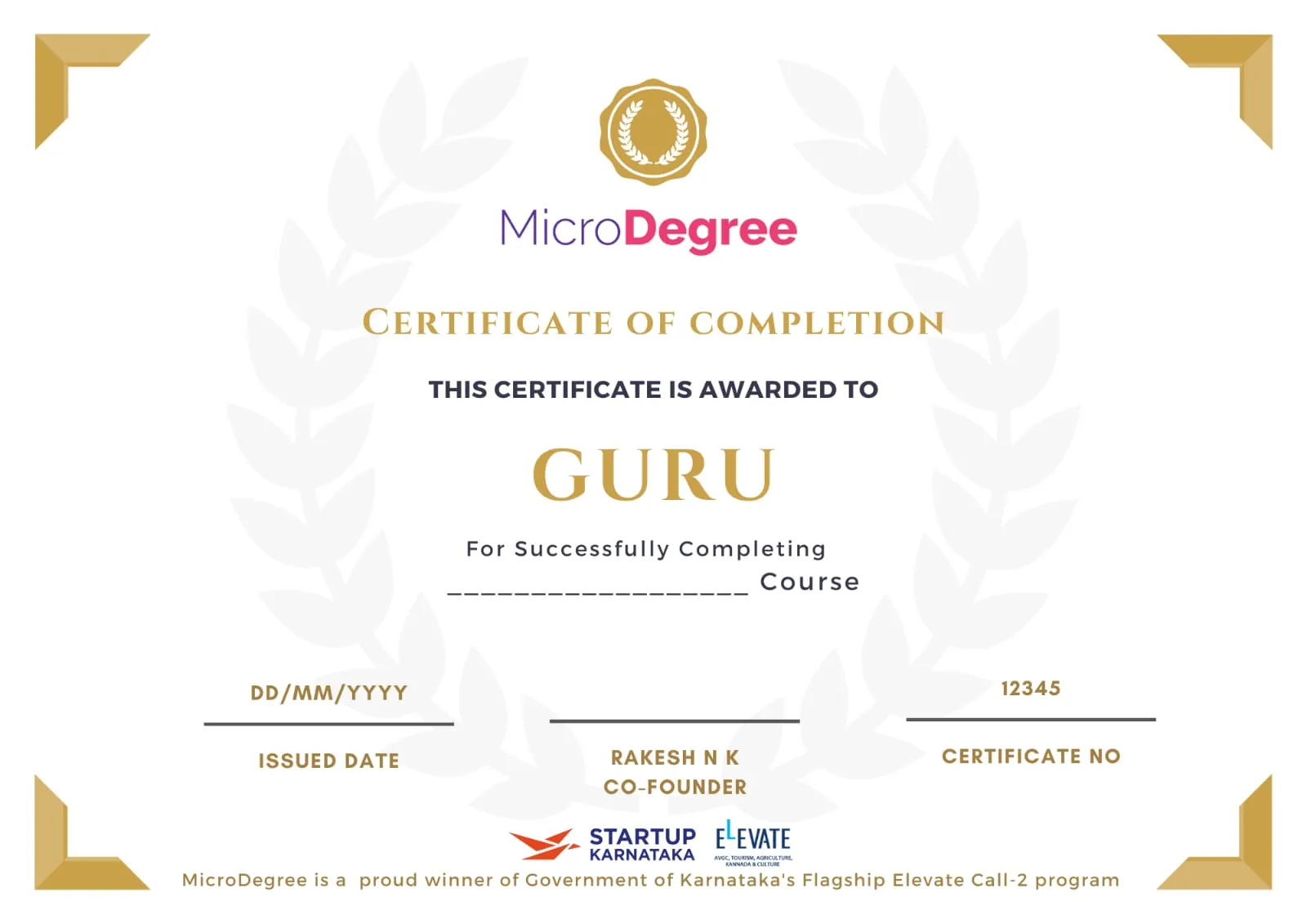
Sample Generative AI course completion certificate awarded by MicroDegree

Get Course Completion Certificate

Showcase your skills with Course Completion Certificate from Industry experts, validating your Generative AI expertise and boosting your career.

Join Generative AI Certification Program

Pricing Plan

Get our detailed pricing straight to your inbox — just fill out the form below with your details.

Get Your Plan Now

Checkout our GenAI Videos

Start learning Generative AI in Kannada, from the roadmap to building AI agents.

AI Agents vs Generative AI vs Agentic AI
Gen AI Roadmap for 2026

Awards & Recognition

MicroDegree is proud to be acknowledged by some prominent publications and organizations

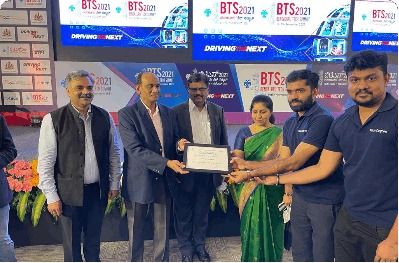
Karnataka Digital Economy Mission Recognition at BTS
21nov

Karnataka Digital Economy Mission Recognition at BTS

MicroDegree receiving an award for its impactful work at the grassroots level.
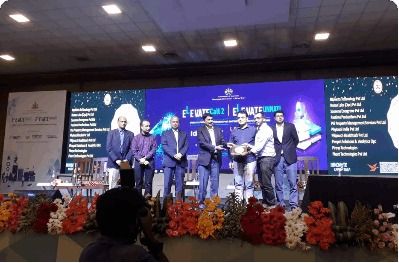
Winning Startup Elevate 2020
20mar

Winning Startup Elevate 2020

MicroDegree chosen as one of the top 100 startups by Govt. of Karnataka.
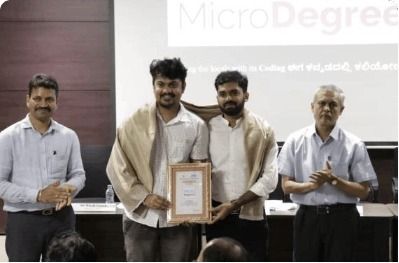
Awarded by IEEE
21feb

Awarded by IEEE

MicroDegree impacted 3000+ rural talent imparting tech sessions in Kannada.
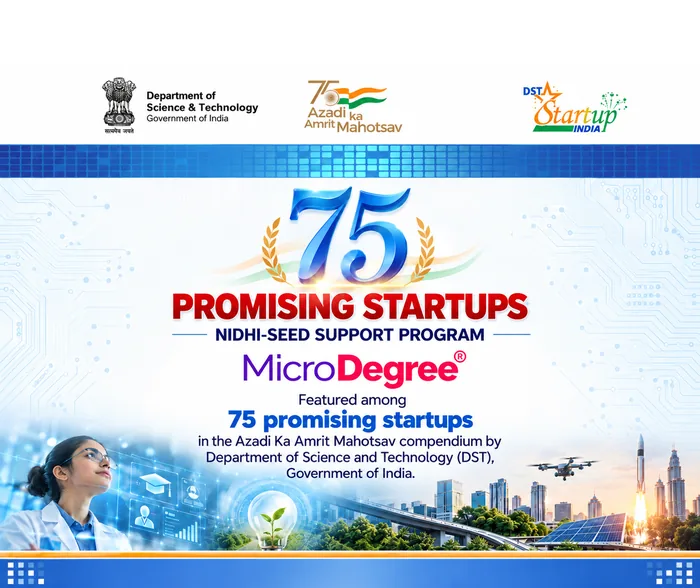
NIDHI Seed Support Program
16jan

NIDHI Seed Support Program

MicroDegree featured among 75 promising startups in the Azadi Ka Amrit Mahotsav compendium

Learners Review

Our Expert Trainers are from

We are backed by

Karnataka Digital Economy Mission recognitionStartup Karnataka RecognitionIEEE RecognitionTiECon Recognition for MicroDegree

Frequently Asked Questions

What is the duration of dashboard access?

All live sessions are recorded and uploaded daily. You will have access to these recordings for 1 year from your enrollment date.

Is there flexibility in choosing batches?

Yes! You can join any of our morning or evening batches. Within 1 year of your enrollment, you may switch batches and complete your program as per your convenience.

What is the duration of the program?

We offer multiple learning plans. Depending on the plan you choose, the program duration can range from 3 months to 6 months.

How does career assistance work?

  • We organize a Placement Drive every 2nd & 4th Saturday.
  • During the drive, we assess your hands-on skills.
  • Our team will line up interview opportunities for you within 6 months of clearing the placement drive.

What is your refund policy?

We follow a session-based + time-based refund system to ensure fairness for students and protect against misuse.

Refund Timeline:

  1. 100% Refund – Request within 24 hours of payment
  2. 50% Refund – Request within 4 days of batch start OR before attending up to 2 sessions (whichever is earlier)
  3. 25% Refund – Request within 7 days of batch start OR before attending up to 5 sessions (whichever is earlier)